Water is this unique medium that envelops you and seems to offer no resistance, that can carry you but cannot be held.
To hold it, a container is needed to give the water a shape and boundary, and then a second container to allow the water to flow from one to the other.
So macht es nach den ursprünglichen Ganzkörpererfahrungen des ‘Ich bin (wieder) drinnen und wunderbar umhüllt und alles ist eins (wie vor meiner Geburt)' neue taktile und mental-emotionale Erfahrungen mit der äußeren Welt möglich.
Now one cup is empty and sad. The other is full, and happy or proud, and is happy to pour something into the poor empty container.
Here we see how thinking and the first symbolic functions are born through empathy when the necessary external circumstances are present. For without a suitable container, water cannot be caught or an empty cup filled. Just as a hungry baby cannot be fed or comforted without an empathetic mother figure.
The shaping of the containers creates basic mental abilities:
1. eigene mentale VORSTELLUNGEN, die sich aus dem aktiven und interessierten Hantieren mit Gegenständen in der Umwelt entwickeln, vor allem aus dem Erleben von GEGENTEILEN, das voller intensiver Gefühle ist, wie voll-leer, da-weg, rein-raus, drinnen-draußen, meins-nicht meins (deins kommt viel später), allein/verlassen-aufgehoben/geliebt/sicher ...
2. to be able to endure FRUSTRATIONS and unpleasant feelings and to be interested in how one can deal with them oneself. This in turn requires the ability to imagine, as well as the possibility of such experiences, e.g. checking whether the favorite toy is still upstairs in the bathroom, where it ‘lives’, or where the ball we were playing with has just disappeared to.
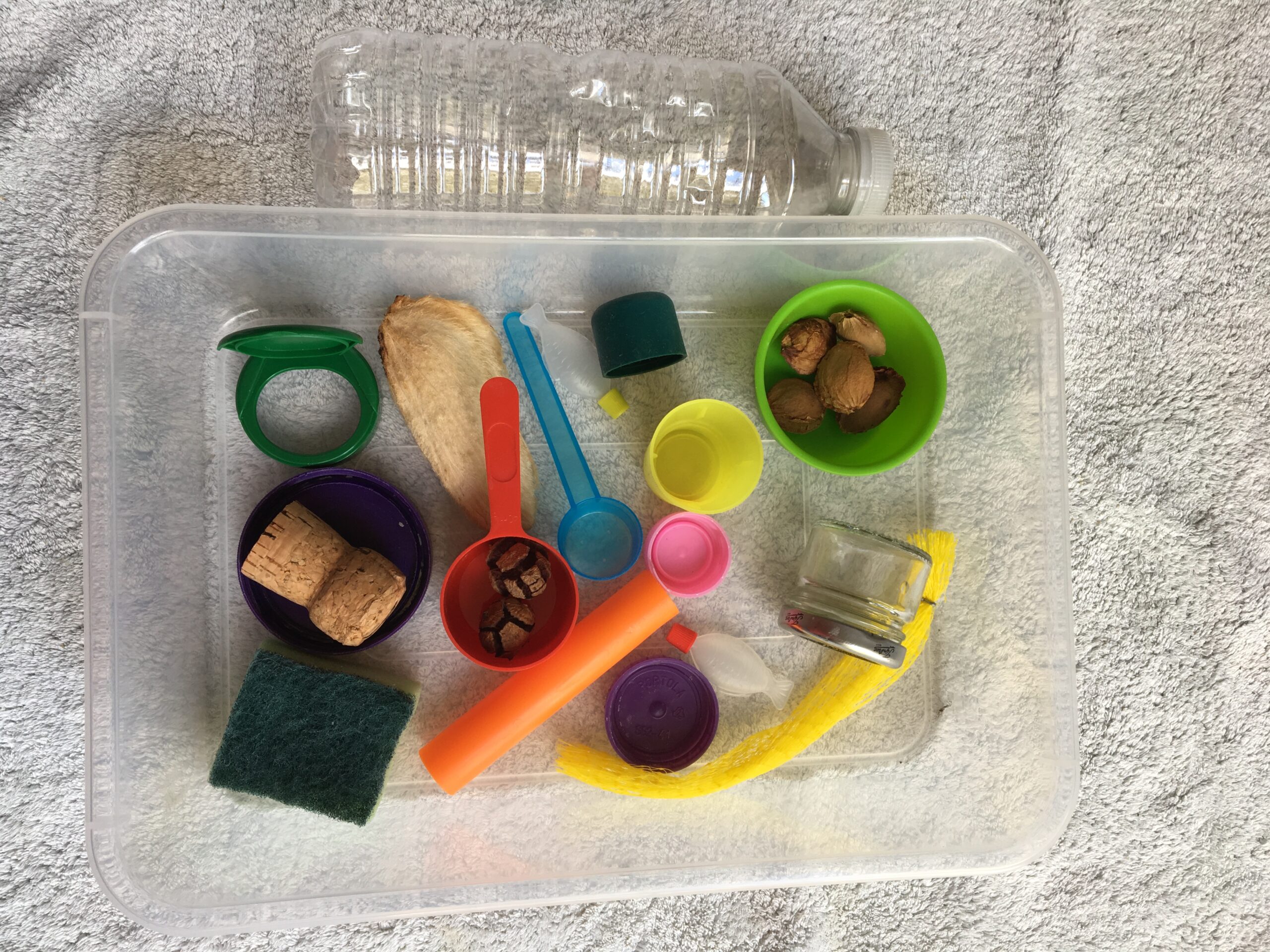
3. having discovered their own HANDS and actively handling objects in order to try out what they can and cannot be used for, e.g. that the balls on the sound tree run down, but corks do not, but can be put into the plastic bottle.
4. as the next development step after the ‘water phase’, this again requires enough of 2 fundamental basic materials:
- CONTAINERS of various types and
- LOSE TEILE, die sich hin- und her-, rein- und rausräumen lassen, wie z.B. Korken, Klötze, Sand, aber auch Kartoffeln, Schuhe, Linsen, Bohnen, ...
Water feature at the table:
Water play at the table allows children to actively engage with water using their hands and gain new experiences. Because learning comes from doing.
It starts with the preparations to create a safe atmosphere, as there is no need to worry about spilled water:
- Towel on the table,
- Wasser in einer GESCHLOSSENEN Flasche (die NUR vom Erwachsenen 'bedient' wird!)
- a flat tray NOT larger than approximately A4 format
- various SMALL containers
- KLEINE 'Handwerkzeuge: Schöpflöffel (z.B. Kaffee- oder Babymilchpulverlöffel), verschiedene Schwämme, um Wasser aufzusaugen/auszudrücken, kleiner Trichter, kleines Netz, Teesieb, ...
- LEINE 'lose Teile', die sich mit dem Löffel hin- und hertransportieren lassen oder anderweitig interessant sind, weil sie zum Beispiel schwimmen oder sinken, oder mit denen man etwas machen kann.